Apriil 2013 Meetup – The Unlikely Pilgrimage of Harold Fry by Rachel Joyce

‘There’s no way I’m going to be able to read this,’ I said as I put the book down and  looked at my partner before realising what an absolute snob that made me sound, so I picked it back up and hoped he hadn’t judged me too much. I found the first page infuriating. Thanks Rachel, thanks so much for telling me that the protagonist just received ‘the letter that would change his life forever’. You know, I never would have worked that out unless you explicitly pointed it out to me.

Before I get loyal fans of this book hunting me down and bashing me with tea cosies, I had best quickly say now that I love this book. I adore this book. I feel warm and fuzzy when I look at this book on my shelf. This book made me get angry when Harold turned away from the door of the care home the first time to the point that I couldn’t go out for Sunday lunch with my partner and his parents until I had read on a bit to see that he did eventually go in. Yes, I am that idiotic. It made me feel intense feelings of ignorance and sympathy for cancer sufferers when I read the description of Queeny in her bed. And, I was no doubt physically gritting my teeth when the other people in Harold’s walking group got all the glory. After an initial unnecessary cock-up over the telling us too much about the letter, Rachel Joyce heads full steam ahead on an incredibly original emotional journey full of suspense,

For those who haven’t read it, this book follows the journey of a man called Harold Fry, as he walks the length of the country to reach someone called Queeny who is terminally ill. The letter that he receives at the beginning of the book is from Queeny telling him that she is ill, and immediately after reading it Harold decides to say goodbye to his wife and set off on foot with no real preparation or suitable walking equipment.  We are left to speculate on the nature of the relationship between Harold and Queeny, and why it is so important for him to reach her in this way.

It is a journey is all senses of the word; it is a journey for his wife, their marriage, his grief, other people in his life, and for us as readers. Harold and his wife, Maureen, share the narrating of this book, allowing us an insight into both minds and allowing us to change our feelings towards Maureen as time goes on. In many ways, Maureen has an equally significant journey of hew own, and neither character resemble the people that they were before Harold set off.

There are so many nicey nicey twee elements to this book, full of loveable characters, interspersed with plenty of good old fashioned British settings of tea rooms and bed and breakfasts, and it is complete with a happy ending, that it is easy to think of it as a cosy read and to overlook many of the darker, more serious elements and philosophical meanderings throughout. Let us not forget the struggles of the immigrant who was unable to find work in her field of expertise, the kind words of the girl who worked at the burger van and how easy it would have been to judge her. Let us remember how the different ways of grieving over the death of a son can test a marriage to its limits. Let us think about the feelings of the lonely neighbour.

Joyce encourages us to think about many things:

  • How not to judge people too soon:

 It must be the same all over England. People were buying milk, or filling their cars with petrol, or even posting letters. And what no one else knew was the appalling weight of the thing they were carrying inside. The superhuman effort it took sometimes to be normal, and a part of things that appeared both easy and everyday.

Harold could no longer pass a stranger without acknowledging the truth that everyone was the same, and also unique; and that this was the dilemma of being human.”

  • How life is just about keeping going each day, however small a distance you may travel:

The world was made up of people putting one foot in front of the other; and a life might appear ordinary simple because the person living it had been doing so for a long time

  • How it is not straightforward to ask for and receive help, and to be receptive to the kindness of strangers:

“The kindness of the woman with the food came back to him, and that of Martina. They had offered him comfort and shelter, even when he was afraid of taking them, and in accepting he had learned something new. It was as much of a gift to receive as it was to give, requiring as it did both courage and humility.”

How we should slow down and be more Zen

“He must have driven this way countless times, and yet he had no memory of the scenery. He must have been so caught up in the day’s agenda, and arriving punctually at their destination, that the land beyond the car had been no more than a wash of one green, and a backdrop of one hill. Life was very different when you walked through it.”

Unfortunately I was not the hugest fan of some of her style of writing, for instance when she labours the point slightly:

“I’ve begun to think we sit far more than we’re supposed to.” He smiled. “Why else would we have feet?”

However, despite a few corny lines, I cannot fault her storytelling, the plot, the way she wouldn’t let me put the book down, and the way I felt a genuine pang of sadness when I realised that Harold wasn’t going to be walking through Usk anytime soon for me to cheer on. And when someone creates something that you know you could never do then are you really able to criticise that much?

Although there can be some pretentious sentences, I have yet to read a less pretentious character as Harold. At  one point he complains about someone who was losing control:

“He wished the man would honor the true meaning of words, instead of using them as ammunition.”

I could not agree more. I cannot abide the use of words merely to hurt when instead people should use the correct word for their feelings and not just harsher ones than necessary.  This endeared me to Harold even more.

We all love you, Harold, and I would like to think that I would have been one of the people who stopped and maybe had a burger with you one day on the side of the road. Sadly, I would probably have joined the masses in judging you and driving on.

Thanks for the education, Harold.

Future Meetups:

May 29th Carter Beats the Devil by Glen David Gold
June 18th Gangsta Granny by David Walliams
July 31st And The Mountains Echoed by Khaled Hosseini
August 31st The Gargoyle by Andrew Davidson
September 25th The Warden by Anthony Trollope and The Spooks Apprentice by Joseph Delaney
October 30th The House of Silk by Anthony Horowitz
November 27th Dovetail by Jeremy Hughes
December 18th A Child’s Christmas in Wales by Dylan Thomas
January 29th 2014 Rebecca by Daphne du Maurier 

Follow on facebook and twitter for updates throughout the month:
@uskbookclub
www.facebook.com/wines.reading.wines
Book Review March 27th 2013 – How to be a Woman by Caitlin Moran

This book was great for a bit of a debate. It wasn’t long before a good ol’ debate opened up about whether we really can/should differentiate people so much into woman and men and separate them so much/ One reader claims to be more of a ‘personist’ than a feminist and does not like the idea of people being so pigeon-holed into groups. Although she didn’t say it explicitly in this book, Moran does agree with this is some of her other writing:

 “I’m neither ‘pro-women’ nor ‘anti-men’. I’m just ‘Thumbs up for the six billion”

Another reader believes that there is a lot of truth behind the  ‘men are from mars and women are from venus’ concepts, and that a deeper understanding of these ideas can greatly improve relationships.

One of the men in the group did not really get on with Caitlin Moran’s style of writing and found it quite annoying. The elements that were most interesting to the men in the group seemed to be the writing about family life growing up as this was something that they could relate to more. I agree to a small degree. There were some bits that seemed a little over the top for me, but on the whole it was interesting and difficult to put down. I’m glad that we read it as a group, and that there were men at the meetup who were happy to give it a go and give us their opinion.

I personally found it most interesting in its discussion of what it means to be a feminist. It is easy to think that in order to label yourself a feminist you must have done something actively feminist like marching somewhere wearing only your bra, or not wearing your bra, or reading Germaine Greer. Moran makes us all realise how important it is to question what we believe the word ‘feminsim’ to mean, and if we believe in equal rights then we should not be afraid to call ourselves a feminist.

“But, of course, you might be asking yourself, ‘Am I a feminist? I might not be. I don’t know! I still don’t know what it is! …  So here is the quick way of working out if you’re a feminist. Put your hand in your pants.

a) Do you have a vagina? and b) Do you want to be in charge of it?

If you said ‘yes’ to both, then congratulations! You’re a feminist.”

“What is feminism? Simply the belief that women should be as free as men, however nuts, dim, deluded, badly dressed, fat, receding, lazy and smug they might be. Are you a feminist? Hahaha. Of course you are.”

“When statistics come in saying that only 29 percent of American women would describe themselves as feminist – and only 42 percent of British women – I used to think, What do you think feminism IS, ladies? What part of ‘liberation for women’ is not for you? Is it freedom to vote? The right not to be owned by the man you marry? The campaign for equal pay? ‘Vogue’ by Madonna? Jeans? Did all that good shit GET ON YOUR NERVES? Or were you just DRUNK AT THE TIME OF SURVEY?”

She does make amusing points agains those who think that they are against feminism and why they contradict themselves, as they are getting paid as an independent woman as they write it:

“These days, however, I am much calmer – since I realised that it’s technically impossible for a woman to argue against feminism. Without feminism, you wouldn’t be allowed to have a debate on women’s place in society. You’d be too busy giving birth on the kitchen floor – biting down on a wooden spoon, so as not to disturb the men’s card game – before going back to quick-liming the dunny. This is why those female columnists in the Daily Mail – giving daily wail against feminism – amuse me. They paid you £1,600 for that, dear, I think. And I bet it’s going in your bank account, and not your husband’s. The more women argue loudly, against feminism, the more they both prove it exists and that they enjoy its hard-won privileges.”

Yes her writing can sometimes get a little over the top in parts but let us not ignore some of the important messages that she is getting across under her humour and sensational use of the c*** word, and, most importantly, the people she is getting this across too. She is clearly doing her best to target as many readers as possible who may not read academic literature on feminism and the female plight throughout history. She is targetting readers who may not even want to learn about feminism but just wanted to read something funny about how to be a woman and who will not be able to not learn about feminism by reading it. From talking about this book with friends I have found out that there are many young people reading this who really do need to read this. She talks about porn like she is talking about baking a cake, and getting very important messages about self respect, choice, freedom and power across to the most important audience – those who don’t think they are feminists.

As a mother (Moran, not me), I found it refreshing that she was able to write so convincingly about the validity of a life without children. As someone who currently has one eye on the biological clock and one eye on the globe that I could travel if I didn’t have to find a hostel that had a crèche, I am constantly frustrated by comments implying that I cannot have a truly fulfilling life if I do not have biological children. To read someone able to wax lyrical about the joys that her own children have brought her, but who also stands up strongly for those who do not have children, can describe the positives of that choice, and who can justify her decision to have an abortion, to me was so comforting. She really is able to lay out the bigger picture. She rightly challenges the negative connotations inherent in not having children which is extremely ingrained in society and is severely da

“But deciding not to have children is a very, very hard decision for a woman to make: the atmosphere is worryingly inconducive to saying, “I choose not to,” or “it all sounds a bit vile, tbh.” We call these women “selfish” The inference of the word “childless” is negative: one of lack, and loss. We think of nonmothers as rangy lone wolves–rattling around, as dangerous as teenage boys or men. We make women feel that their narrative has ground to a halt in their thirities if they don’t “finish things” properly and have children.”

“If you want to know what’s in motherhood for you, as a woman, then – in truth – it’s nothing you couldn’t get from, say, reading the 100 greatest books in human history; learning a foreign language well enough to argue in it; climbing hills; loving recklessly; sitting quietly, alone, in the dawn; drinking whisky with revolutionaries; learning to do close-hand magic; swimming in a river in winter; growing foxgloves, peas and roses; calling your mum; singing while you walk; being polite; and always, always helping strangers. No one has ever claimed for a moment that childless men have missed out on a vital aspect of their existence, and were the poorer, and crippled by it.”

This is comforting reading from someone who is also brimming with joy at motherhood in many other passages:

“…there is the sheer emotional, intellectual, physical, chemical pleasure of your children. The honest truth is that the world holds no greater gratification than lying in bed with your children, putting your leg on top of them in a semi-crushing manner, while saying sternly, “You are a poo.”

“It’s the silliness–the profligacy, and the silliness–that’s so dizzying: a seven-year-old will run downstairs, kiss you hard, and then run back upstairs again, all in less than 30 seconds. It’s as urgent an item on their daily agenda as eating or singing. It’s like being mugged by Cupid.”

At the end of the day, whatever you think of her, don’t be too harsh. She has said nice things about libraries:

 “A library in the middle of a community is a cross between an emergency exit, a life-raft and a festival. They are cathedrals of the mind; hospitals of the soul; theme parks of the imagination. On a cold rainy island, they are the only sheltered public spaces where you are not a consumer, but a citizen instead”

Thanks to everyone for coming and making it such an interesting evening.

Future Meetups:

April 24th The Unlikely Pilgrimage of Harold Fry by Rachel Joyce

May 29th Carter Beats the Devil by Glen David Gold

June 18th Gangsta Granny by David Walliams

July 31st And The Mountains Echoed by Khaled Hosseini

August 31st The Gargoyle by Andrew Davidson 

 September 25th The Warden by Anthony Trollope and The Spooks Apprentice by Joseph Delaney

October 30th The House of Silk by Anthony Horowitz

November 27th Dovetail by Jeremy Hughes

December 18th A Child’s Christmas in Wales by Dylan Thomas

January 29th 2014 Rebecca by Daphne du Maurier 


August 2013 Meetup – The Gargoyle by Andrew Davidson

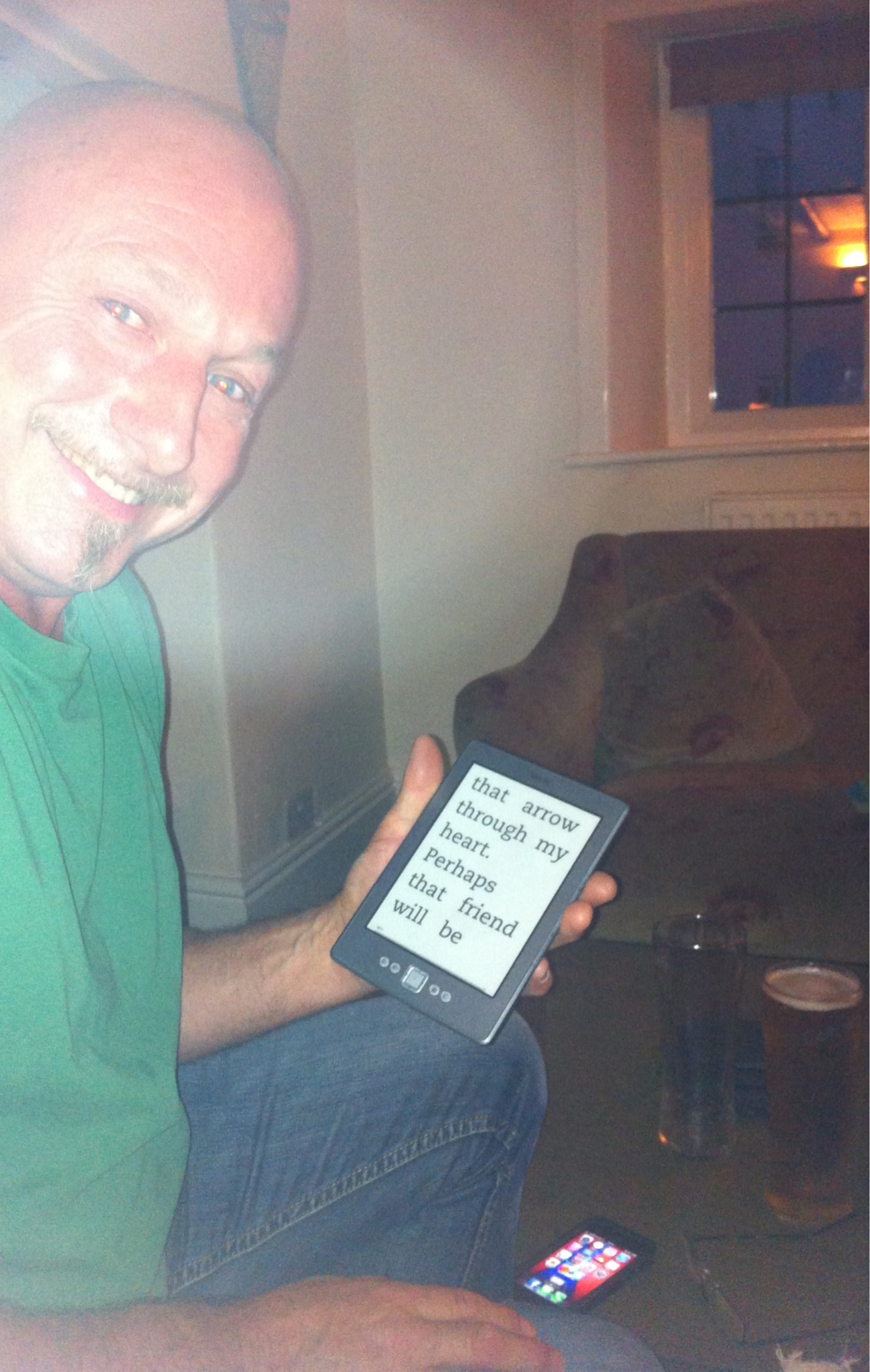
On the last Wednesday of August The Llangybi Literati joined forces in The White Hart once again, this time to discuss The Gargoyle by Andrew Davidson. We were an impressive 10, with two newcomers to the group, Jenny and Mansel, who I hope have been converted and will join us again in THE social night of the month. We also had a Whyman imposter at the end who joined us for the After Party and who we may manage to convert in the future if we all chip in for a Kindle so that he can read the book at his favourite font size.

paul kindleDespite quite a lot of cheating this month with people openly admitting that they only read the first and last chapters, most people finished it like good little students. Overall, everyone seemed to find the book incredibly unique and interesting.

For those who have not read the book (and for the cheats who only read the first and last chapter!) the book follows the ex pornstar narrator’s recovery from being burned in a car accident which is portrayed to the reader in exquisitely written detail but it is sometimes quite uncomfortable to read. Alongside this is an intricately woven 14th century love story between the narrator and the schizophrenic sculptress Marianne, in their alleged past life. Many questions are raised about the nature of God, Hell, Love and Sexuality.

The famous first chapter

There were mixed reviews among the group about the opening first chapter in which the author goes into graphic detail to describe his experience of being severely burned in a car accident. Some people found this a compelling start to a novel because of its originality, others found it off-putting and would not have ordinarily continued had it not been for the book club, and others were surprised at how much they enjoyed it because they are normally quite squeamish. Whatever your reaction to the first chapter there is no denying that it is memorable, and stunning in terms of its originality. Here is a very short section where we are invited to imagine being burnt.

I imagine, dear reader, that you’ve had some experience with heat. Perhaps you’ve tipped a boiling kettle at the wrong angle and the steam crept up your sleeve; or, in a youthful dare, you held a match between your fingers for as long as you could. Hasn’t everyone, at least once, filled the bathtub with overly hot water and forgot to dip in a toe before committing the whole foot? If you’ve only had these kinds of minor incidents, I want you to imagine something new. Imagine turning on one of the elements of your stove — let’s say it’s the electric kind with black coils on top. Don’t put a pot of water on the element, because the water only absorbs the heat and uses it to boil. Maybe some tiny tendrils of smoke curl up from a previous spill on the burner. A slight violet tinge will appear, nestled there in the black rings, and then the element assumes some reddish-purple tones, like unripe blackberries. It moves towards orange and finally — finally! — an intense glowing red. Kind of beautiful, isn’t it? Now, lower your head so that your eyes are even with the top of the stove and you can peer through the shimmering waves rising up. Think of those old movies where the hero finds himself looking across the desert at an unexpected oasis. I want you to trace the fingertips of your left hand gently across your right palm, noting the way your skin registers even the lightest touch. If someone else were doing it, you might even be turned on. Now, slam that sensitive, responsive hand directly onto that glowing element.

And hold it there. Hold it there as the element scorches Dante’s nine rings right into your palm, allowing you to grasp Hell in your hand forever. Let the heat engrave the skin, the muscles, the tendons; let it smolder down to the bone. Wait for the burn to embed itself so far into you that you don’t know if you’ll ever be able to let go of that coil. It won’t be long until the stench of your own burning flesh wafts up, grabbing your nose hairs and refusing to let go, and you smell your body burn.

I want you to keep that hand pressed down, for a slow count of sixty. No cheating. One Mis-sis-sip-pi, two Mis-sis-sip-pi, three Mis-sis-sip-pii.i.i.i At sixty Mis-sis-sip-pi, your hand will have melted so that it now surrounds the element, becoming fused with it. Now rip your flesh free.

I have another task for you: lean down, turn your head to one side, and slap your cheek on the same element. I’ll let you choose which side of your face. Again sixty Mississippis; no cheating. The convenient thing is that your ear is right there to capture the snap, crackle, and pop of your flesh.

Later in the book we are confronted with another graphic description, that of the attack against the narrator by the trackers from the condotta. I personally found this much more difficult to read, and the overall opinion of the group was that this later chapter was much more difficult to stomach for a number of reasons. Firstly, we naturally care a lot more about the narrator at this point, and so any violence towards him is going to toy with our loyalties. Secondly, an accident is by its very nature very different to being tortured. Thirdly, it is clear that there he will die as a result of the attack whereas he slowly recovers from the accident.

God

The Radio’s presence at last month’s meetup encouraged a step up in my hostess duties which must have spilled over into this month too as I came armed with a list of questions and felt really rather professional. One of the questions I asked was a clever one about God that I stole from the Internet.

How did Marianne’s experience of God evolve and mature throughout her life? How do you personally reconcile the concept of a loving God and the reality of human suffering.

I felt that the answer to the first part was that she kept her strong faith but that this evolved to allow for her own happiness as well, but when it came to the second part I was relying on Drew, our retired vicar. Unfortunately, as he was unable to make it to this month’s wineclub bookclub, I requested that his wife channel him in to the room and give us his answer. So as not to cause their divorce by citing Anne incorrectly I am going to keep this cowardly vague and simply say that his answer to the question (and please bear in mind Anne’s wine in-take and her powers of clairvoyancy) is that he thinks that the idea of a benevolent God is a tricky one to hold, and that one must be open-minded to the balance of love and hate within a God. This sparked up various analogies to Star Wars and the Jedi Knights, and how everything requires a balance to achieve order. The only thing I know less about that religion is Star Wars, so I smiled and nodded.

Hell

As well as being thick-skinned enough to read the uncomfortable bits in the book, whether that be his accident, his painful recovery procedures, his intricate suicide plan, or his torture in the 14th Century, an awareness of Dante’s Inferno and the nine rings of Hell wouldn’t go amiss either, as it is a central theme throughout. The 9 rings of Dante’s hell are first introduced to us in the first chapter:

Hold it there as the element scorches Dante’s nine rings right into your palm, allowing you to grasp Hell in your hand forever’

and then recur several times throughout the book in hallucinations and discussions about Hell. This themes is so underlying that we are left wondering whether the accident in the beginning of the book is actually one of his hallucinations of Hell after all. This book really challenges the reader’s notion of Hell. It is not to be considered a uniform Hell, and instead it is your own version. In the stories about Iceland, for instance, the author reveals that Hell in this country is generally considered to be an area full of ice.

‘This makes sense: having spent their entire lives hammered  down by the frigid  climate, how could they fear anything more than an eternal version of the same thing.?’

This probably means that our British view of hell should be of a below par short British summer on the cusp of having a full week’s sunshine but never quite getting there. With us all chained to cider stained beer garden tables with immortal wasps.

That Hell is tailored to the individual is hardly a new idea. It is, in fact, one of the greatest  artistic triumphs in Dante’s Inferno; the punishment for every sinner fits his sin. The Souls of the Carnal, who in life were swept away by the gusting fits of their passion, are in death doomed to be carried on the winds of a never-ending tempest. The Souls of the Simoniacs, who in life offended  ‘god by abusing the privileged of their holy offices , are doomed to burn upside down in fiery baptismal fonts. The Souls of the Flatterers spend eternity buried in excrement , a reminder of the shit they spoke on Earth.

The Ending

The overall opinion on the ending was that it was a little lacking for some of us, with the impression being given that he ran out of time and wanted it finished to get his money. Not the best impression you can get of an ending. Then again, how could this book end in way that does justice to all the different styles in the books, and that encompasses all the trials and tribulations that we have been though as readers. The writing style rapidly oscillates between surrealism and contemporary realism and readers are bound to drawn towards one more than the other and feel a sense of disappointment if the final chapter is written in their least favourite style.  A couple of readers agreed that it would have felt more fitting to leave the book with Marianne walking out into the sea. This would also have paved the way nicely for a second book, but would have stopped the narrator revealing his dilemma over whether to save her from drowning or not. This contemplation of what he should have done harks back to the earlier thoughts of the narrator (p. 328)

‘It made me wonder what my version of Hell  – if I believed in such at thing, that is – would be like. Would I be doomed to burn forever, tapped inside my car? Or would hell be a never-ending stint on the debridement table? Or would it be the discovery that when I was finally able to love, it was already too late?’

Favourite quotes:

There are too many for me to choose but I liked:

‘Everyone’s past is nothing more than the collection of memories they choose to remember.’

‘Any man who believes he can describe love understands nothing about it’

‘The cliché goes that at twenty a person has the face that God gave him, but at forty he has the face he has earned’

Nadia felt that the book was a hug love story full of sacrifices for love and a discussion of the decisions that we make for those we love, and that this passage sums up the essence of the book for her:

I remembered then that he had deliberately inhaled his wife’s plague before commanding his brother to shoot him through with an arrow. “Is this what Hell is like for you?”  “My choice to die came within hours of my inevitable death, and it was a decision made with love, not cowardice. An important distinction to remember.” He paused for a moment, then added, “Although my afterlife is not this one, there is a reason that I am your guide here.”

For Paul, the book was about a journey, which can be summed up in the following passage:

But Nietzche was wrong. I was born beautiful and lived beautifully for thirty-plus years, and during all that time I never once allowed my soul to know love. My unblemished skin was numb armor used to attract women with its shininess, while repelling any true emotion and protecting the wearer. The most erotic of actions were merely technical : sex was mechanics, conquest a hobby; my body constantly used, but rarely enjoyed. In short, I was born with all the advantages that a monster never had, and I chose to disregard them all. Now my armor had melted away and been replaced with a raw wound. The line of beauty that I had used to separate myself from people was gone, replaced by a new barrier – ugliness – that kept people away from me, whether I liked it or not. One might expect the result to be the same, but that was not entirely true. While I was now surrounded by far fewer people than before, they were far better people. When my former acquaintances took a quick glance at me in the burn ward before turning around to walk out, they left the door open for Marianne Engel. Nan Edwards, Gregor Hnatiuk, and Sayuri Mizumoto.

I’d like to end with a quote from p236 which is about how people can meet and find common ground through literature, books, and reading, no matter what their backgrounds or opinions are, and I would like to think this is something that we do at bookclub J

‘I’d read you what I had finished the night before. It felt as if we were sharing something wicked…the story took us each to a different place. The rough language and the harsh imagery brought me towards your world, but the religious ideas brought you towards my life of spirituality. Somehow we met in the middle.’

Next Month…
Join us on the 25th September at The White Hart, 7pm, where we will be discussing two books:The Warden by Anthony Trollope and The Spook’s Apprentice by Joseph Delaney.

Follow on facebook and twitter for updates throughout the month:
@uskbookclub
www.facebook.com/wines.reading.wines

Future Meetups:
October 30th The House of Silk by Anthony Horowitz
November 27th Dovetail by Jeremy Hughes
December 18th A Child’s Christmas in Wales by Dylan Thomas
January 29th 2014 Rebecca by Daphne du Maurier


REVIEW OF JUNE’S MEETUP – GANGSTA GRANNY by DAVID WALLIAMS

I love my book club, I really do. Where else could I sit outside a pub on a weeknight and legitimately get drunk just that little bit too early while talking about how much I love David Walliams’s children’s books without people thinking I was weird. I’m aware people still retain the right to think that, but when surrounded by a fair number of other people doing the same they are less likely to sit there pointing and screwing up their faces, and hopefully more likely to wonder what’s wrong with them for not doing it.

The important stuff first: June’s meetup kicked off with a complimentary bottle of wine from the White Hart Llangybi as way of an apology for a slight venue/date mix up the previous month. It was unnecessarily generous but very gratefully received, not least by Anne, who bounced through the door with her hair swinging from side to side as she excitedly told us that she had been told a the bar that there was already wine outside for her.

Priorities sorted out, we moved onto the book which was a winner on all accounts. It was chosen by our youngest, and most sensible member, L who is 9 and has very good taste. At the moment her taste is restricted to the book choices but it wont be long before she will be making just a great choices from the wine list.

A few people thought that Walliams was a little ageist at the beginning of the book, but this was mainly by those members who probably didn’t want the rest of us to think that they really did cabbage farts. Careful you don’t protest too much though, yeah? Oh, and one member is actually growing cabbage seeds in their allotment. All these possible ageist issues were tackled throughout the book when granny turns gangsta and wows her grandson and the readers with her alter ego. As not all of the members had read the book (yes, it really is that relaxed!), the book was summarised beautifully by the girl who chose it and it was at this point that I suddenly had a vivid memory of what it felt like to really love a book at that age.

It was revealed by Anne, that this was the first book that we have read with the book club that made her cry. If you know Anne then you will know that it is not the most shocking news, but it is a milestone nonetheless.  (Anne is someone who cried profusely when watching a boy see his dad fall off the travelator on Gladiators)

Anne also admitted that when she read the part about the granny doing naked yoga she thought ‘I don’t look anything like that’, but then saw the illustration and then thought ‘Ah, I do!’. I personally think it is a huge lie and hope that my chocking on my wine from laughter didn’t imply otherwise at the time.

Favourite character:  a few of us really like the newsagent as we have all met someone similar.

Favourite illustration: most of us said the queen flashing her Union Jack knickers.

Likes/Dislikes: There were too many lists and barcharts for some people (one of them being Anne who incidentally is the inventor of the human barchart), and there were not enough lists for the book chooser. Another favourite part was the cabbage recipe which the book chooser read out to us and made us all feel queasy.

We then discussed what makes children’s literature so different from adult literature and how do some people manage to get it so right?

Overall it was a very well liked book and we would all happily read another David Walliams book.

Thanks to everyone for coming.

We meet the last Weds of the month, in venues in and around Usk. Check with me or the fb page for event details.

Upcoming meetups….

  • July 31st                The Blind Assassin by Margaret Atwood & And The Mountains Echoed by Khaled Hosseini (with BBC Radio Wales attending to hear our discussion)
  • August  28th      The Gargoyle by Andrew Davidson
  • Sept 25th               The Warden by Anthony Trollope & The Spooks Apprentice by Joseph Delaney
  • October 30th       The House of Silk by Anthony Horowitz
  • November 27th  TBC
  • December             Date and Book TBC
  • January 2014   Rebecca by Daphne du Maurier