
Hey folks and folkettes,
Here is a short story I wrote about a night out in Aberystwyth.
Hey folks and folkettes,
Here is a short story I wrote about a night out in Aberystwyth.
“I’m neither ‘pro-women’ nor ‘anti-men’. I’m just ‘Thumbs up for the six billion”
Another reader believes that there is a lot of truth behind the ‘men are from mars and women are from venus’ concepts, and that a deeper understanding of these ideas can greatly improve relationships.
One of the men in the group did not really get on with Caitlin Moran’s style of writing and found it quite annoying. The elements that were most interesting to the men in the group seemed to be the writing about family life growing up as this was something that they could relate to more. I agree to a small degree. There were some bits that seemed a little over the top for me, but on the whole it was interesting and difficult to put down. I’m glad that we read it as a group, and that there were men at the meetup who were happy to give it a go and give us their opinion.
I personally found it most interesting in its discussion of what it means to be a feminist. It is easy to think that in order to label yourself a feminist you must have done something actively feminist like marching somewhere wearing only your bra, or not wearing your bra, or reading Germaine Greer. Moran makes us all realise how important it is to question what we believe the word ‘feminsim’ to mean, and if we believe in equal rights then we should not be afraid to call ourselves a feminist.
“But, of course, you might be asking yourself, ‘Am I a feminist? I might not be. I don’t know! I still don’t know what it is! … So here is the quick way of working out if you’re a feminist. Put your hand in your pants.
a) Do you have a vagina? and b) Do you want to be in charge of it?
If you said ‘yes’ to both, then congratulations! You’re a feminist.”
“What is feminism? Simply the belief that women should be as free as men, however nuts, dim, deluded, badly dressed, fat, receding, lazy and smug they might be. Are you a feminist? Hahaha. Of course you are.”
“When statistics come in saying that only 29 percent of American women would describe themselves as feminist – and only 42 percent of British women – I used to think, What do you think feminism IS, ladies? What part of ‘liberation for women’ is not for you? Is it freedom to vote? The right not to be owned by the man you marry? The campaign for equal pay? ‘Vogue’ by Madonna? Jeans? Did all that good shit GET ON YOUR NERVES? Or were you just DRUNK AT THE TIME OF SURVEY?”
She does make amusing points agains those who think that they are against feminism and why they contradict themselves, as they are getting paid as an independent woman as they write it:
“These days, however, I am much calmer – since I realised that it’s technically impossible for a woman to argue against feminism. Without feminism, you wouldn’t be allowed to have a debate on women’s place in society. You’d be too busy giving birth on the kitchen floor – biting down on a wooden spoon, so as not to disturb the men’s card game – before going back to quick-liming the dunny. This is why those female columnists in the Daily Mail – giving daily wail against feminism – amuse me. They paid you £1,600 for that, dear, I think. And I bet it’s going in your bank account, and not your husband’s. The more women argue loudly, against feminism, the more they both prove it exists and that they enjoy its hard-won privileges.”
Yes her writing can sometimes get a little over the top in parts but let us not ignore some of the important messages that she is getting across under her humour and sensational use of the c*** word, and, most importantly, the people she is getting this across too. She is clearly doing her best to target as many readers as possible who may not read academic literature on feminism and the female plight throughout history. She is targetting readers who may not even want to learn about feminism but just wanted to read something funny about how to be a woman and who will not be able to not learn about feminism by reading it. From talking about this book with friends I have found out that there are many young people reading this who really do need to read this. She talks about porn like she is talking about baking a cake, and getting very important messages about self respect, choice, freedom and power across to the most important audience – those who don’t think they are feminists.
As a mother (Moran, not me), I found it refreshing that she was able to write so convincingly about the validity of a life without children. As someone who currently has one eye on the biological clock and one eye on the globe that I could travel if I didn’t have to find a hostel that had a crèche, I am constantly frustrated by comments implying that I cannot have a truly fulfilling life if I do not have biological children. To read someone able to wax lyrical about the joys that her own children have brought her, but who also stands up strongly for those who do not have children, can describe the positives of that choice, and who can justify her decision to have an abortion, to me was so comforting. She really is able to lay out the bigger picture. She rightly challenges the negative connotations inherent in not having children which is extremely ingrained in society and is severely da
“But deciding not to have children is a very, very hard decision for a woman to make: the atmosphere is worryingly inconducive to saying, “I choose not to,” or “it all sounds a bit vile, tbh.” We call these women “selfish” The inference of the word “childless” is negative: one of lack, and loss. We think of nonmothers as rangy lone wolves–rattling around, as dangerous as teenage boys or men. We make women feel that their narrative has ground to a halt in their thirities if they don’t “finish things” properly and have children.”
“If you want to know what’s in motherhood for you, as a woman, then – in truth – it’s nothing you couldn’t get from, say, reading the 100 greatest books in human history; learning a foreign language well enough to argue in it; climbing hills; loving recklessly; sitting quietly, alone, in the dawn; drinking whisky with revolutionaries; learning to do close-hand magic; swimming in a river in winter; growing foxgloves, peas and roses; calling your mum; singing while you walk; being polite; and always, always helping strangers. No one has ever claimed for a moment that childless men have missed out on a vital aspect of their existence, and were the poorer, and crippled by it.”
This is comforting reading from someone who is also brimming with joy at motherhood in many other passages:
“…there is the sheer emotional, intellectual, physical, chemical pleasure of your children. The honest truth is that the world holds no greater gratification than lying in bed with your children, putting your leg on top of them in a semi-crushing manner, while saying sternly, “You are a poo.”
“It’s the silliness–the profligacy, and the silliness–that’s so dizzying: a seven-year-old will run downstairs, kiss you hard, and then run back upstairs again, all in less than 30 seconds. It’s as urgent an item on their daily agenda as eating or singing. It’s like being mugged by Cupid.”
At the end of the day, whatever you think of her, don’t be too harsh. She has said nice things about libraries:
“A library in the middle of a community is a cross between an emergency exit, a life-raft and a festival. They are cathedrals of the mind; hospitals of the soul; theme parks of the imagination. On a cold rainy island, they are the only sheltered public spaces where you are not a consumer, but a citizen instead”
Thanks to everyone for coming and making it such an interesting evening.
Future Meetups:
April 24th The Unlikely Pilgrimage of Harold Fry by Rachel Joyce
May 29th Carter Beats the Devil by Glen David Gold
June 18th Gangsta Granny by David Walliams
July 31st And The Mountains Echoed by Khaled Hosseini
August 31st The Gargoyle by Andrew Davidson
September 25th The Warden by Anthony Trollope and The Spooks Apprentice by Joseph Delaney
October 30th The House of Silk by Anthony Horowitz
November 27th Dovetail by Jeremy Hughes
December 18th A Child’s Christmas in Wales by Dylan Thomas
January 29th 2014 Rebecca by Daphne du Maurier
I write this article as someone who is more into Charlotte Bronte than Chemistry and Biology, who would prefer to read Phileas Fogg than a Physics Blog, who knows more about Alan Bennett than Alan Turing, who is more into Charles Dickens than Charles Darwin and who has read everything by Stephen Fry and not a word by Stephen Hawking.
I also write this article as a Technical Author in the Semiconductor field.
My pathway to Technical Authorship has not been conventional and I would like others to be able to see that it is not a career solely for engineers with an average of 15 years of industry knowledge.
My degree was in Italian, and I followed this with postgraduate study in Translation Studies during which time I avoided the Technical Translation options like the plague in favour of much more flowery literary translation. I then went into the Children’s Book Division in publishing.
It was a move home to Wales that resulted in me applying for a job as a Technical Author. The job description asked for a degree in engineering but I was fortunate to be offered the role based on previous experience in a publications department, good qualifications in English at ALevel, publishable English from the Translation Studies course, and my agreement and enthusiasm to study for a Diploma in Technical Authorship and to undergo product training.
Having been in the role for almost two years, upon reflection I can see how nearly all of the skills that I learned as a translator are utilised daily. My main area of postgraduate research was in the area of crossing cultural boundaries. In translation this means conveying the message from one culture to another and using appropriate language for the target audience in order to get the message from the source text across despite an assumed lack of understanding of the source culture. Transferring cultural references requires only some knowledge of the source culture, but extensive knowledge of the target culture and audience. Similarly, technical authoring requires the transference of the Subject Matter Expert’s knowledge to the target audience according to their knowledge and requirements. This also requires only some knowledge of the industry (source culture) and extensive knowledge of the target audience so as to make the end result comprehensible.
In translation, the target audience is the deciding factor in any choice of word that is translated, and we cannot simply choose the style of language that we like or think sounds nice. We as translators are the portal between the two sides. Instead of a foreign language, we are dealing with complex engineering procedures, and instead of literary English the target language is comprehensible instructions, tailored to the audience’s education and experience.
I am close to completing the second part of the Technical Authorship course and I have discovered that I enjoy many elements of commercial writing. It challenges me and I am always learning something new. My aim is to complete the course and do as much freelance commercial writing as possible. I find it varied and am enjoying the balance between creativity and fixed structure.
The specifics of the content required for technical authorship and commercial writing can be learned, and it is the communication skills, an aptitude for precision in document production, an eye for detail, and enjoyment of writing that will prove successful in this career. I am in no way disputing the fact that hands on experience in the desired field, combined with study of Technical Authorship or strong English skills, is a very appealing combination for an employer, but it is also very true and often overlooked that one can be taught how a piece of machinery is assembled but it is harder to impart an aptitude with language and experience in producing accurate publishable pieces of work.
In light of this, and my own experience, I would like Technical Authorship and Commercial Writing to be more accessible to those with an Arts background.
Chatting online to victims of bullying, and taking someone with Asperger’s Syndrome out for lunch seems to bear no relation to writing manuals and bulletins for an engineering company. On the surface it seems as though my life outside work bears no relation to the work that I do during the day, and that the Third Sector is a million miles away from the engineering and manufacturing industry.
It was not until completing the Certificate in Technical Communication Skills with the ISTC, and however, that I realised, on closer inspection at the communication skills involved, that there is a great deal of overlap between the two facets of my life.
My full time job is as a Technical Author for a semiconductor fabrication equipment manufacturer. I am responsible for the distilling of bulletins and manuals for customers and internal support staff. Being relatively new to this line of work I rely on communicating with the SMEs (subject-matter experts) for content clarification.
In order to create manuals and bulletins we currently use Adobe Framemaker and Acrobat, with the graphics created by two in-house technical illustrators, using Photoshop, IsoDraw, and CorelDraw. For online sharing of documents we use Sharepoint.
I work in a team of 5 and our role as a Technical Publications department is to provide support not only to the customer but also to the internal customer support team and the customer support staff out in the field, as both customer and support staff are required to provide support and maintenance of the of the tool at the customer site. As a result, the intended audience is always forefront in my mind with any communication, and the content of relevant documentation amended accordingly.
In order to achieve the best possible results, the company were keen for myself and another Technical Author in the department to train with the ISTC, and we recently both passed the Certificate in Technical Communication Skills. As a result have enrolled on the second part of the course, the Diploma in Technical and Commercial Authorship, which we hope to complete in the next 12 months.
During our study we learnt about the six Cs of communication and how communication must be:
Clear, Concise, Constructive, Correct, Courteous, Complete.
Other communication skills involved in my role include the understanding of how people absorb information, and the ability to grasp complex issues and distil them into good operational instructions, and having a consistent approach to all communication. A closer look at my work outside of Technical Authoring will highlight how transferable these communication skills are. Other than my job at SPTS Technologies, I work part time in the evenings for Bullies Out and volunteer on the weekends for The National Autistic Society.
Bullies Out
I started volunteering with this antibullying charity as on online mentor in 2008, and have since spent two evening shifts a week chatting to victims of bullying in the designated chat room. The issues that we as mentors are required to deal with often include talking online to children who are considering suicide or who are in hospital recovering from suicide attempts. When communicating with depressed or suicidal individuals it is imperative to be clear in what you say, and concise in your message. It is definitely essential to be courteous and constructive, as well as being correct, proving all the necessary information about further help that they could get and organisations they could contact.
Often we need to research police and social worker contact details, and various procedures such as how to report various domestic abuse claims, and this information has to be gathered and distilled quickly and accurately while the child is online. There are many rules about data protection that have to be adhered to and ethical considerations, so the mentors must constantly think about what they are communicating and the different audiences, whether it be the child or their foster carer. Confidentiality is also factor, which is also a consideration for a lot of the documentation produced as a Technical Author, where other customers’ details are concerned.
As well as continuing to mentor, I have recently been appointed as the Online Mentor Manager, which involves managing the scheme as a whole and maintaining communication pathways between the mentors and the CEO of the charity. The main aspect of the role is to monitor the chat room, and each evening I request summaries of the session from each mentor who was online, collate this information, decide what is relevant to and produce a summary to circulate to the rest of the charity staff so that they can be kept up to date with what issues were discussed. This requires a concise and consistent approach, and to collate writing from all different styles into one concise summary. Another main part of the role involves writing procedures for new mentors to follow and compiling case studies for training.
National Autistic Society
My other role for charity is as a befriender for the National Autistic Society, which involves meeting with a girl who has Aspergers every week and to help them with their social skills. Communicating with a person on the Autistic Spectrum requires clarity above anything else, and the aim is to be concise and not ambiguous. It is a good idea to use Simplified English where possible, and not to be overly verbose.
The girl I meet with struggles with long sentences and with sentences that include metaphors, similes or ambiguous words, or if the sentence goes off track at all. She benefits from a consistent approach and courteous communication that is positive and constructive.
In order to help with my volunteer work I completed an Introduction to Counselling module with The Open University, and the overlaps between counselling and technical communicating are many. Above all, the communication must be clear and concise, with the communication tailored to the situation.
I hope that both aspects of my life will continue to assist the other, with constant reflection of the communication techniques required.
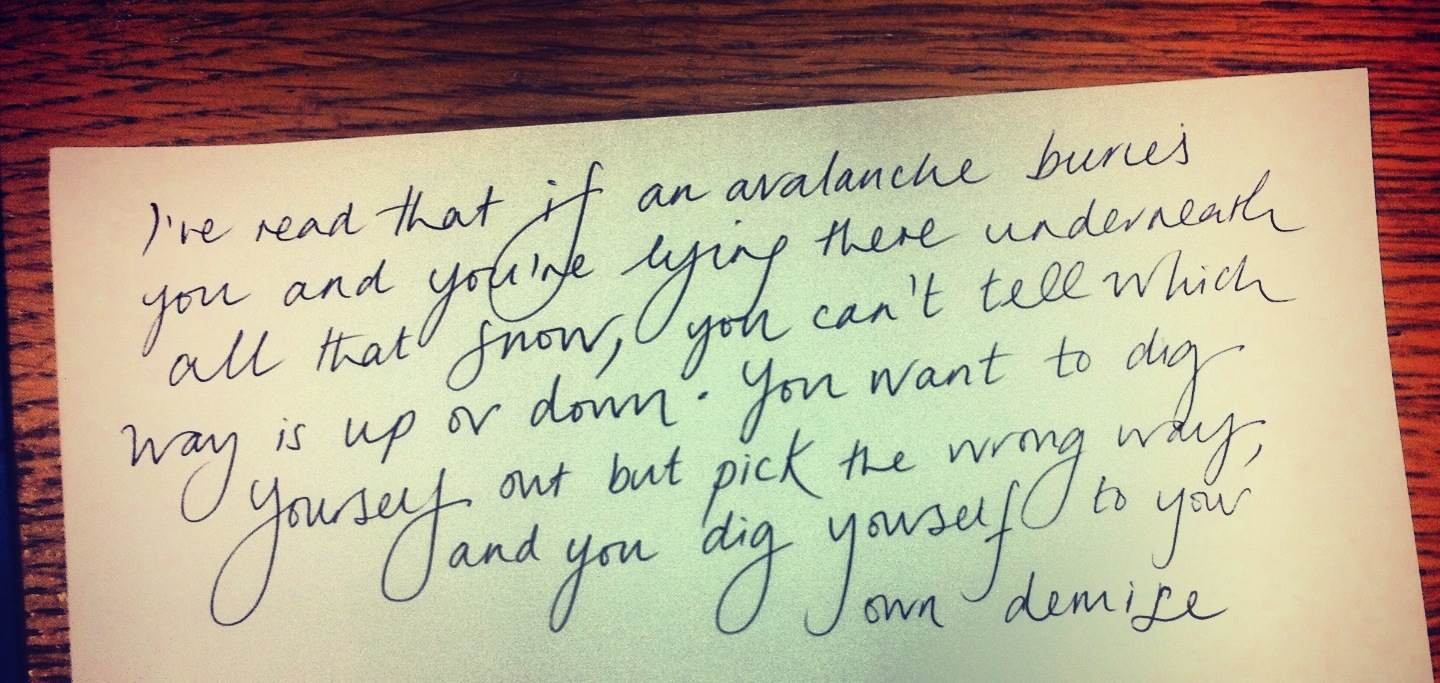
Some of my favourite quotes from Khaled Hosseini’s ‘And The Mountains Echoed’ so far.

 Lucy Rose Williams