The P45 Diaries by Ben Hatch

july(June 2014 meetup)

The book:
The P45 Diaries by Ben Hatch
This book is a semi-autobiographical account of the protagonist’s coming of age, following his journey as he gets sacked from a number of jobs from working in a kebab house where he didn’t realise he had to take the skewer out of the chicken before putting it in a pitta, and various others, including macdonalds, and a stint with a builder. As funny as it is to read about his blaze of glory exits from the workplace, there is the undercurrent of him dealing with the bereavement following the death of his mother, and the consequently tumultuous relationship with his father who is the Head of BBC 2 and desperately trying to get his son to hold down a job.  Another main theme is his rejection of the corporate world and his inability to embrace maturity, so when the ending sees him being accepted onto a journalism course the reader is relieved to witness this first step towards some stability in his life and his entrance into adulthood.

We loved….
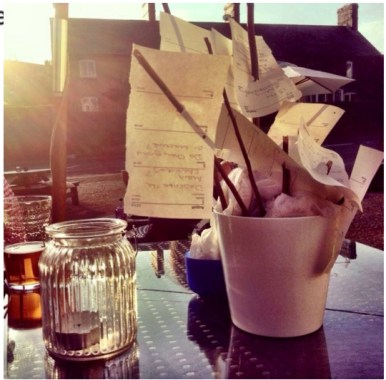
The humour and change in style from some of the ‘heavier’ books we have been reading, and the way that the book managed to tackle some really heavy issues such as bereavement, the deterioration of someone before death, while making us laugh out loud. There was a refreshing mix of humour, honesty, and seriousness. We also loved the al fresco setting, and michelle’s epic diary style question tree (see photo!), complete with Welsh cakes! A hard act to follow for next month but I’m sure she will.

We didn’t love….
that Michelle got stuck in traffic and was late and that we were actually going to have to think of something to say unprompted! Also, a few of us thought that perhaps the humour was a little forced in places, especially the beginning, until it became a bit meatier.

We disagreed….
about very much this time. On the whole we all enjoyed it, and everyone who finished it said that they did not expect the ending.

We digressed….
and talked about the difference between bronchitis and pleurisy. We obviously missed the last couple of months’ medicinal themes and wanted to give our brains a workout. Thanks to Robin, our resident microbiologist, we learnt a lot about lungs. We also talked about the possibility of branching out and going to the cinema to watch the film adaptations of books we have read. This led to a discussion about the release of 50 Shades of Grey as a film, and there seems to be more demand for Mansel to reinstate his weekly readings from the book.
 

Life Class by Pat Barker and The Husband’s Secret by Liane Moriaty

(Aug 2014 Meetup)

The books:

  • Life Class  by Pat Barker
  • The Husband’s Secret by Liane Moriaty.

We loved….
…both books in their own way. They were quite different in a number of ways. Life Class is a heavier piece of work, and the only book that has ever made Chloe cry! and The Husband’s Secret is more of a lighter page turner which makes you ask yourself how you would react if in the same position of discovering the secret.  Most of us agreed that we would read other titles by the same authors, and not many of us had a clue what the secret was until we got to it.

We didn’t love….
…some of Moriaty’s ‘easy’ writing style in places, where she tended to fill in too much information, losing some subtlety even though the plot was gripping. Some of us weren’t that keen on the title either. As for Life Class, some found the scene where Elinor sneaks to the Front completely unbelievable. It was noted that all the characters change over the course of the war apart from Elinor who claims all the way through that she wants to stay true to her art and nothing else, but one of the artists of the bookclub group felt that you cannot be a true artist if you do not embrace change. Interestingly, those reading it on an ereader  who were unable to get information from the cover and the blurb, found it difficult to work out which era it was set in for quite a while.

We disagreed….
…quite strongly about whether the number and type of events that occur to the people The Husband’s Secret were realistic. Some believed that it was unrealistic to have so many dramatic instances in the lives of the group of characters and that the book would have benefitted from fewer dramas. Others firmly believed that a lot of bad things can happen to people in short spaces of time. Some felt that the dramas were just added to make it like a soap opera, whereas others felt that it portrayed the real lives of real people and how they deal with such events.

We digressed….
and talked about the recently released film, Lucy, which discusses the idea of primal instincts in relation to the mother’s in The Husband’s Secret doing whatever necessary to protect their families. We also discussed whether we would have read the letter in the attic and I believe it was a unanimous yes!

The Fault in Our Stars by John Green and Do No Harm by Dr. Henry Marsh

(April 2014 Meetup)

The books…
This month had a medicinal theme.

  • The Fault in Our Stars is a fictional novel about two young people who have cancer, and the book follows their lives and their love story.
  • Do No Harm is the non-fiction account of a top neurosurgeon who lays bare the trials and tribulations of his profession with admirable honesty.

We loved….
…everything about The Fault in Our Stars from the characters to the plot to the writing. It is moving and had a strong impact on us all. We loved most things about Do No Harm, especially the fact that Anne features in one of the chapters. We loved learning more about the intricacies of the surgery, and the refreshing honesty of the author who explains how one can only become an expert at anything by making mistakes, but that unfortunately the mistakes in brain surgery are often fatal.

We didn’t love….
…the trailer to the film of The Fault in Our Stars which we fear will not do justice to the writing. Some of us didn’t like the arrogance of Dr. Marsh in Do No Harm.

We disagreed….
…on quite a lot this month actually! There were conflicting thoughts from the Arts and Sciences. Some thought that Scientists are generally the ones who make the effort to cross over into the Arts, whereas others felt as though Scientists gave the impression of being superior. The attitude of Dr Marsh was seen by some as a necessary confidence and arrogance for the type of profession, but by others as sheer egotism. There was a difference of opinion in the quality of the writing, with most people finding it creative and enjoyable but others feeling like it was too scientific.

We digressed….  
and talked about how cancer has touched our own lives, and how much this book is spot on with a lot of what it says about the support groups and attitudes of others. We agreed how it is a real shame that this is marketed as teenage fiction and therefore may not be picked off the shelves by enough adults.

An Outdoor Scene (a freewrite)

Outside the office I can hear the traffic flowing along the dual carriageway, with a large roundabout facilitating everyone’s movement. The sound of the rain mixes with the engines to create a gritty swish of relentless noise outside the window.

The wind zigzags through the few token trees which struggle to stay green amidst the grey weeds circling their roots. At this time of day, as the offices release their workers onto the greying turf the dutiful roundabout starts to heave with fatigue, taking deeper and deeper breaths as it breathes in the approaching  cars, swirls them around and around, then spits them out the other side. The rows of cars at the edge of the shore keep growing, becoming huge tidal waves, swelling and roaring while they wait for the next wave.

People sit motionless in their cars staring ahead at the monster they must face. As they trickle forward towards their sacrifice they think of the other side and how if they just get through this, another day, they will make some changes. They just need to get through the sea storm ahead of them.

During the dead time before the storm there are people who are listening to the same radio station because their mouths are moving along in time to the same songs and I wonder what everyone sounds like inside their bubbles. They are tapping the steering wheel and waiting for their turn in the storm.

Meeting Rachel Joyce – Her Take on Writing for Radio

meetingracheljoyce

Me getting her next book signed

This is a little shout out to people embarking on writing for Radio.

In the middle of October (2014 – yes I am that behind the time in posting this), in Chepstow Library in Wales, a crowd of us dragged a chair up to listen to the loveable Rachel Joyce talk about writing for radio.

It is difficult not to be drawn into Rachel’s world. With her long ruffled skirt and Victorian boots, just looking at her made you feel like you were in another world.

I don’t know if any of you have read The Unlikely Pilgrimage of Harold Fry by Rachel Joyce. If you have you will be surprised to hear that she is not someone who described herself as a novelist beforehand. It turns out that she is predominantly a playwright, and has been one of the main writers for Radio 4’s afternoon play, and lots of plays for Woman’s Hour. She has also been involved in a lot of adaptation work, adapting the Bronte sisters’ works for radio, and her own novels.

The Unlikely Pilgrimage of Harold Fry tells the story of Harold’s epic walk from one end of the country to another. When he walks out of his front door one day in his usual clothes and shoes, it is clear that he is completely unprepared for his journey. Rachel explains that this was a mirror of her own writing journey. She had no idea how to write the book and likens the writing process to Harold just putting one foot in front of the other and just keeping going every day.

Some of the points she made were relevant to anyone on a Creative Writing course, in particular the A215 Creative Writing Module with The Open University, or indeed any writing course, or journey, so I thought I would write them up and share them with you.

Please note, however, that these are just her thoughts, and not to override any advice from your tutor or coursebook! Just things to think about, I suppose.

When asked about her radio writing she said that you have to remember that the radio can be switched off very quickly and then you have lost your audience.

They are unlikely to turn it back on, or find you on ‘listen again’ once they have made that decision, unlike with a book where the reader may well pick it up again when they have more time or are back in the mood.

Consequently, she feels that radio plays need to have a strong storyline to keep the listener engaged.

Other interesting points Rachel made:

–          In Britain we are one of the only nations left who still have radio drama, so we have to look after it, write it, listen to it, share it, review it etc.

–          Character names are hugely important as they carry a lot of weight

–          Rachel always knows what the end of her play will be, and feels as though the beginning and endings are answers to each other. However, she said that one of her most respected writers (named no names) said that anyone who knew their ending when they started out was dull.

–          Writing every single day is vital to improvement

–          Rachel likes to include a lot of truth in her work. She sees the truth as stepping stones. She will write about/fictionalise something truthful, then see another stepping stone stone of truth ahead of her and have to work out a way to get there.

–          Predominantly a writer for radio, Rachel is not used to writing descriptions at length. She has mainly worked in dialogue, and she found that having prose to write descriptions was like having a load of colours to work with.

–          She said that she often used sound to punctuate action and that certain sounds can be very effective in radio work such as rain and other weather.

–          She said that different writing disciplines flex different writing muscles and that there is merit in trying your hand at all varieties so that you can draw from different ones when needed.

–          In order to adapt prose for radio, especially short plays in episodes, you have to get very used to cutting and being brutal. You have to look for that hook for each episode and allow time to remind the listener of what happened in the previous episode. In her adaptations of one of the Bronte stories she had to cut whole scenes and remove whole characters entirely in order to give the main focus to the main characters.

–          Her next book about Queenie Hennessy is being dramatised on the radio in 5 or 6 episodes so for anyone who has read it you can see how she adapted it for radio.

–          The Unlikely Pilgrimage of Harold Fry was also on the radio and is going to be a film in a year or two so it could be interesting to see how the book, radio play, film differ.